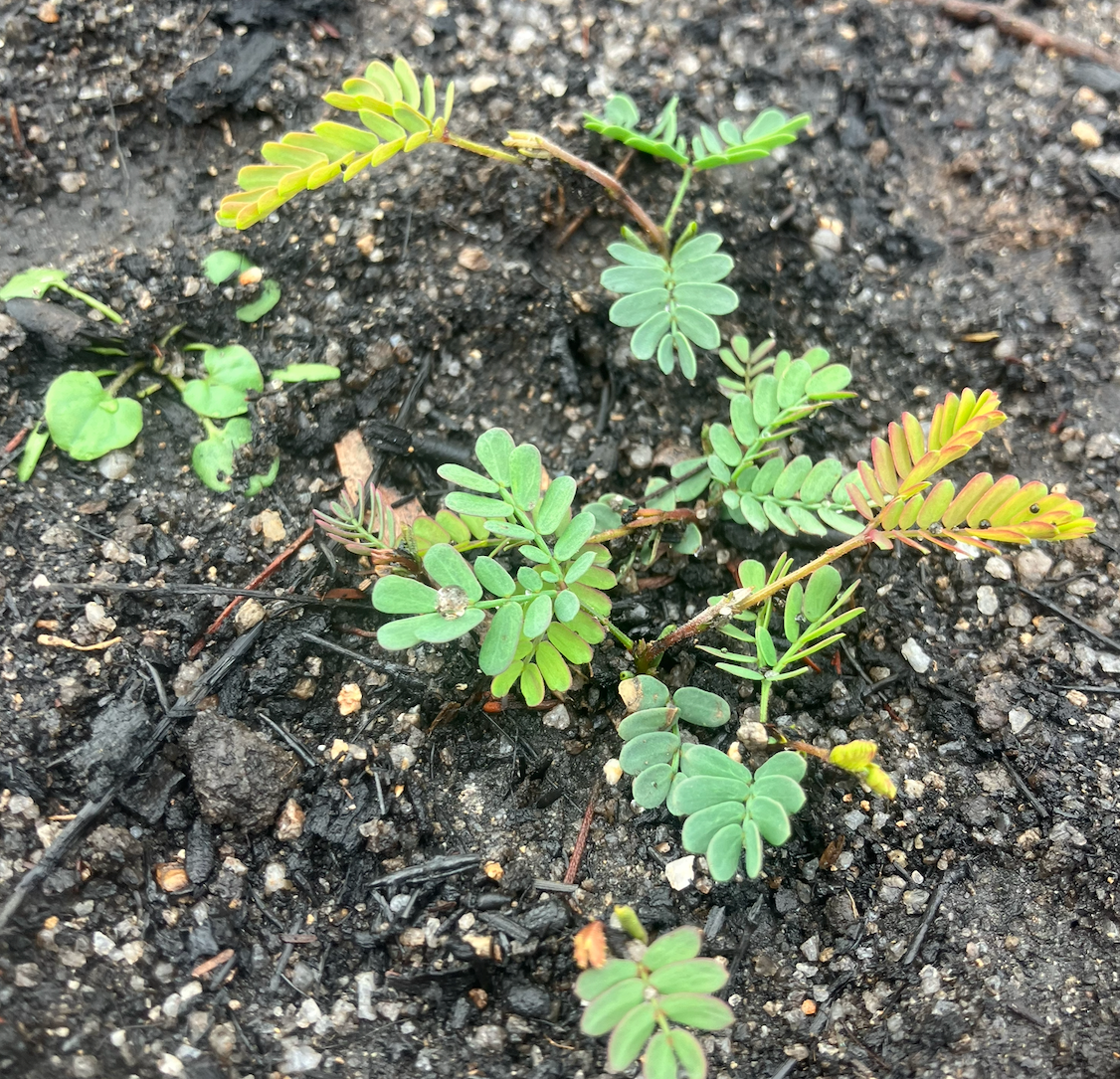
Australia is adapted to fire – yes? These statements are true – to some extent. On a recent walk in the burnt country near Ruffy, I was encouraged to see 5 plants of Woolly Wattle with little seedlings under their branches. Woolly Wattle, Acacia lanigera var lanigera is listed as Vulnerable, and these 5 plants are all that exist across the Tablelands. They have been munched by deer for years and have not produced any new seedlings for at least a decade that have been noted. Those few little germinants were cause for celebration. Kangaroo grasslands, well adapted to fire, were thriving and orchids were abundant. Signs of life were everywhere if you looked hard enough, despite the loss of some truly magnificent, rare old trees. It appears nature is rebounding and the green brings a sense of hope and reassurance.
However, this is only part of the story. Our farming landscape has fragmented biodiversity, and being fragmented, it becomes so much more vulnerable to disturbance. If we liken nature to a knitted jumper, the pattern and function of the jumper works as a whole. Drop a stitch, and a little hole soon develops. If the moths get into your cupboard and eat multiple holes, each stitch starts to unravel and the jumper begins to look pretty ragged and be less functional at keeping you warm. If we cut the jumper into 40 identical pieces, is it still a jumper? Does each little piece display the pattern or function of a jumper? Is it prone to fraying, or loss as it is moved around? Is it vulnerable to mould, decay and fire as 40 separate pieces?
Our farming landscape is a little like our jumper. It is the complexity of nature that supports maximum diversity. Our agricultural landscape, even with sustainable agriculture, will never be as diverse as a native landscape. It is the structure with trees, shrubs, grasses and woody debris that functions as a whole to support a myriad of insects, that then support birds, reptiles and mammals. So what has this to do with recovery from fire?
Our landscape at the moment is terribly vulnerable. It is just beginning to regenerate. However, many of the connections across our land have been burnt, making it impossible for birds, insects and mammals to move across open country and re-populate safely. Many of our insect eating birds, like Yellow Robins or Song Thrush won’t move across much more than a 40m opening in a paddock. We still have introduced predators like cats and foxes, and herbivores like deer and goats, preying on vulnerable plants and animals. We need to act now to protect plants and animals and give them the best chance of regenerating.
G2G, BRA have been building a series of monitoring and action projects to involve community through citizen science and hands on help, to ensure we give our landscape the best shot of recovery.
Thanks to generous help from Rushworth Field and Game and many other groups, we have 150 nest boxes ready to install. Thanks to prompt donations, we have purchased enough marine ply to build another 350 nest boxes and will be distributing the ply to various mens and womens sheds to ‘flat pack’ our boxes so community groups can help with assembly. The Arb bush crew head off for working at heights training tomorrow – the generous donation from Naked Wines will be used to ensure we cover OH and S training and get those nest boxes installed in key locations.
Jemma Norman, with Victorian Game Harvesters and some trusted local shooters has been building a deer control program. There are game cameras installed around Ruffy locations, and early signs are indicating we still have large numbers of deer in the burnt landscape. Its imperative we work cooperatively across the landscape and across public and private land tenure to reduce deer numbers while our bushland and farmland is regenerating. If you are interested in deer control on your property, please get in contact with Jemma and complete a landholder permission form for access purposes. From there, our shooters will coordinate their movements and get in touch with landholders to conduct initial property walks.
To register your interest in having a shooter assist you, please contact Jemma Norman at facilitator.lpcmn@gmail.com
Our first community bird survey begins in Longwood East this Sunday. Participants will be paired with experienced birders and learn how to record their sightings. Building the picture of how our birds are recovering, and who is missing from the picture, helps us understand what else is missing in terms of habitat. Expert Chris Tzaros will be independently completing bird surveys across 40 sites and comparing them with pre-burn information.
In the background, Bert Lobert has been designing a monitoring program for Greater Gliders around Caveat and Dropmore. While Greater Gliders will be our ‘premier’ species to watch for, observation techniques will also provide evidence of other arboreal mammals and deer in the landscape. Janet Hagen is working with Zara Marais to design a spring soak monitoring plan, and will be comparing results with previous surveys conducted some years ago, and Helen McKernan is co-designing a study on the effects of fungi and the significance of beneficial fungi to assist with regeneration after fire. Bronte Haines has outlined a project to watch for grassland recovery with Jessie Sinclair from Zoos Victoria, and I’m developing a plan to keep an eye on our threatened plant species. Allison Trethowan is working on how we can connect you, our community, to each of these activities and creating opportunities to get involved.
We hope that each of these activities will create a template for how we assess and respond to our landscape as it recovers from fire. We hope that it will build a story, and that many of you will choose to be part of the story, in whatever capacity you have to be involved.
So where does our knitted jumper fit in with this story?? Well, our landscape is not a jumper anymore. But if we follow this analogy, it could be a scarf! Or a beanie, or even a vest. Peter Richardson, our final member of the G2G team, has skills in sustainable agriculture. In the words of Janet Hagen, our landscape is a ‘blank canvas’ currently, stripped of fencing and artificial division. Peter will be working with the team on how we identify corridors and links across our landscape, to improve the outcomes and profitability for farming, but also our plants, animals, water quality and soils as they recover from the fire.
Cathy Olive
Development Manager
Euroa Arboretum