Seed Production Areas (SPAs) are dedicated plantings of native trees or shrubs of known seed origin that are managed specifically to produce a reliable supply of high-quality and genetically diverse local seed. At the Euroa Arboretum, these plantings support large-scale ecological restoration projects across the Goulburn Broken region.
Plants in the SPA begin as seed, collected from healthy remnant populations across the region. Seed is sourced from multiple sites to capture local genetic diversity, and usually includes a proportion of seed from warmer and drier regions which builds resilience to future climate conditions. Often, seed from historical SPAs is reintroduced, adding valuable diversity, and further strengthening the genetic base of the planting.
Plants raised for our seed production areas are carefully grown in the Euroa Arboretum nursery before being planted together in rows, allowing for cross pollination, and allowing easy access for watering, maintenance, and future collection.
Avenel SPA


In 2024, staged works began on a new 14-hectare Seed Production Area (SPA) in Avenel, with support from by Goulburn Valley Water, the Natural Resources Conservation Trust, and the Goulburn Broken Catchment Management Authority.Between 2024 and 2025 we planted:
- 1000 Acacia montana (Mallee Wattle),
- 600 Acacia flexifolia (Bent-leaf Wattle),
- 1200 Acacia acinacea (Gold-dust Wattle), and
- 1400 Acacia pycnantha (Golden Wattle).
The Bush Crew prepared the site with slashing and spot-spraying followed by many weeks of planting. In addition, up to 1 hectare was hand-sown with native groundcovers including common everlasting, sticky everlasting, clustered everlasting, and hoary sunray. These plantings represent genetic material from 45 wild populations and 24 existing SPA populations.
Looking forward
Expansion at the Avenel seed orchard will continue this year, with a further 9 hectares to be established through BushBank funding from DEECA. Three additional species—Acacia genistifolia (Spreading Wattle), Acacia verniciflua(Varnish Wattle), and Acacia paradoxa (Hedge Wattle)—will be established, totaling 4,400 plants. Together, these represent seed collected from 42 wild populations and two existing SPA populations. Preparations are already underway, with plants being grown at the Euroa Arboretum Nursery and site works scheduled for autumn.
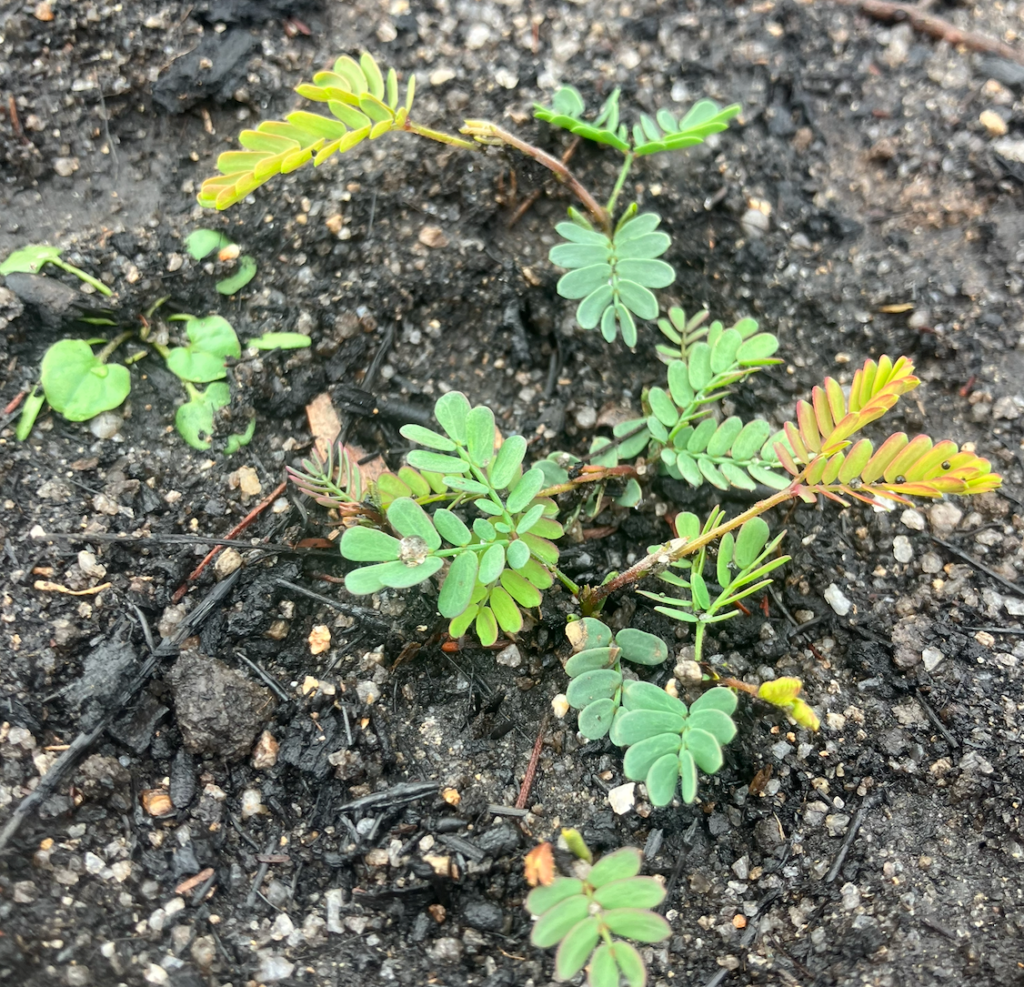
Early signs of growth from previous plantings are encouraging. Acacia flexifolia and Acacia montana are already showing bud development, suggesting that a small initial seed harvest may be possible by the end of the year. Meanwhile, Golden Wattle planted last year has recovered strongly from earlier kangaroo browsing, with new growth now pushing well above the tree guards.
Once completed, the Avenel Seed Orchard will cover close to 25 hectares, and include approximately 8,500 plants across 11 species. It will represent more than 85 wild populations and around 25 historical SPA seed lots.
By concentrating diverse local genetics into one managed planting, SPAs ensure a long-term supply of high-quality bulk seed that can be harvested efficiently, while reducing reliance on limited and vulnerable wild populations.
| Why Seed Production Areas Matter Reliable seed supply: consistent local native seed for large-scale restoration. Protect wild plants: reduce pressure on small or fragmented populations. Boost genetic diversity: mix seed from multiple sources for resilience. Climate-ready plants: include genetics suited to hotter, drier conditions. Efficient harvest: collect large volumes from a single site. Overcome wild limitations: wild seed can be scarce, seasonal, or patchy—SPAs provide a dependable source. |
Bush Crew & Seed Production Area Coordinator