

 …
…

When growing back the bush means burning it a bit
The motto of the Euroa Arboretum is ‘Growing back the bush’. To that end the Arb has been dedicated to restoring landscapes, particularly grassy woodlands on the Arb site in Euroa as well as on public and private land in the Strathbogie Ranges and Longwood Plains areas. What goes hand in hand with ‘bringing back the bush’ is removing exotic (non-native) plants from the landscape. In grassy woodland environments in particular, number one on the hit list of plants to remove are introduced perennial grasses and weeds.
A common way to do this is to use chemicals to poison the plants before they seed. However many of these grasses have built a ‘seed bank’ in the soil. Rather than die off once poisoned, these seeds will sprout for many years. The process of removing perennial grasses and managing grasslands by using fire has gained prominence recently. A fire of the right intensity at the right time can be a useful tool for killing off these grasses and weeds before they seed and can also effectively ‘sterilise’ the seeds that have built up in the soil.

The Arb has used fire to control Annual Veldt Grass (Ehrharta erecta). This plant is an aggressive perennial grass which spreads rapidly excluding many native groundcovers from growing. In conjunction with Phil Hawkey (CFA) and the local Euroa fire brigade an area of Veldt Grass at the Arb was treated with a hot burn in the spring of 2013. In the photograph above the area on the right (where all the exotic grasses are happily growing) has been sprayed for the last five years so as to prevent seed formation…and there is still a healthy grass cover. The area to the left was burned in 2013 and spot sprayed for exotic grasses in 2014. The difference is marked.
Fire also has its place in native vegetation landscapes. As well as removing dead growth from tussock-type plants, and creating bare space between them in which other plants can grow, some native seeds need the intense heat from fire to help them germinate.
At the Arb we will continue to experiment using fire as a tool for removing weeds and also to stimulate native plant regeneration.…

The Olives give the good oil

Last Friday night more than 50 people got the good oil from the Olives, Cathy and Geoff, at the second Clever Country Gardens series dinner talk held at the Flour Mill Gallery in Euroa. The topic was ‘Habitat Gardening’. Using lots of photos and some clever drawings of bird-beaks to illustrate, Cathy talked about creating gardens with the form and structure to attract wildlife – different birds,

butterflies, frogs and lizards. Four sample gardens were featured. Geoff, sitting quietly in the audience, could not help himself while his daughter proudly showed off his garden, and bounded up on stage to explain the design and vegetation.
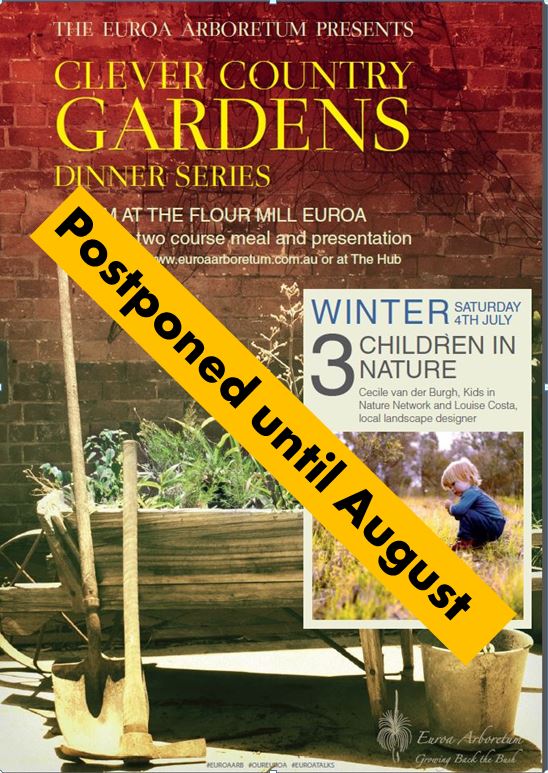
The next dinner talk in the series will be held on Saturday, 4 July, entitled ‘Kids in Nature’.…

It’s a bowling green, right?
Extension of the Euroa golf course? New Euroa Airport site? These are some of the ideas the community has raised to explain the recent ‘landscape’ changes at the Euroa Arboretum. Last week a section of grassland at the Arb was scalped (see photo below)—that is, it had a whole layer of topsoil removed along with the introduced perennial grasses and weeds. And the reason? It is the latest project by Cathy Olive, Project Coordinator at the Arb, to ‘bring back the bush’, using a process pioneered by Dr Paul Gibson Roy from Greening Australia.

Restoring grassy woodlands to their original glory is not easy for a couple of reasons. First, farmers traditionally have applied phosphorus and nitrogen fertiliser to increase the productivity of the land. But native plants prefer low phosphorus and nitrogen in their soil. Second, native grasses and groundcovers struggle to compete with exotic grasses. This is especially a problem because many of these grasses have built a ‘seed bank’ in the soil. And rather than die off once poisoned, these seeds will sprout for many years. As this site was almost entirely dominated by introduced perennial grasses, scalping and subsequent re-seeding was deemed the best technique for restoring the native groundcover diversity.
One way to get rid of the fertiliser and exotic grass seeds is simply to get rid of the top layer of soil. At the Arb, we did some tests at various soil depths and found that removing of 10 cm of topsoil effectively removed the seed bank and left low phosphorus and nitrogen concentrations, which native grasses prefer.

So last week that is what happened. A grader scalped 10 centimetres of soil from a 1.1 hectare site at the Arboretum. The removed soil was piled into two heaps, which we have affectionately named Mt Arb and Little Mt Arb—at 2.5 metres these are the highest landforms around for miles and would have afforded unparalleled views across the Sevens Creek floodplain if the Arb people hadn’t planted all those trees in the way. The mounds provide smaller, more manageable areas to control the exotic grasses and weeds which will no doubt still germinate. In some parts of the scalped area, Onion Grass (Romulea rosea) corms in particular are obvious (see photo below). Some more scalping will be needed to remove these.

So what’s next? The scalped site will be planted with seed from at least 50 species of native grasses, groundcovers and shrubs using a direct seeding device operated by Greening Australia. ‘Photo points’ will be set up from which we will periodically take photos to assess how this latest trial is going. And of course we will compare the growth in the scalped and reseeded site with an equivalent untouched site immediately next door.
Who knew that the Arb vision of ‘bringing back the bush’ would involve a bit of ‘bulldozing the weeds and soil’?…
Clever Country Gardens #2 is here
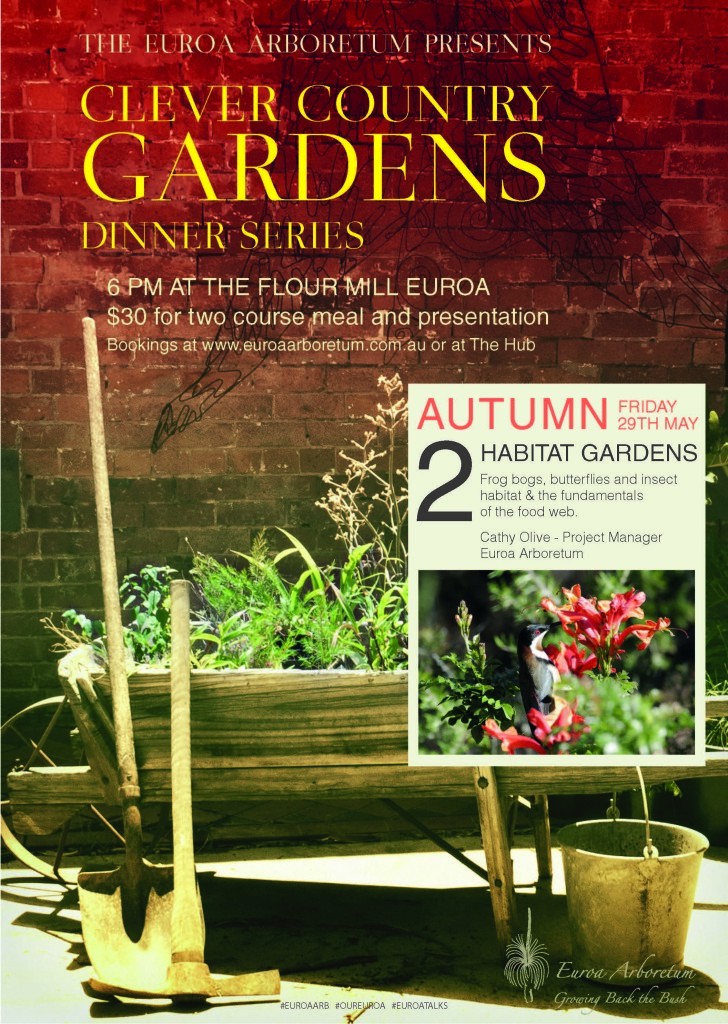
Following on from the very successful SUMMER dinner talk on Arid Gardening presented by Andrew Laidlaw comes the AUTUMN talk. The topic of this presentation is Habitat Gardens and the fundamentals of the food web.
Cathy Olive, Project Officer with the Euroa Arboretum, will present an entertaining talk on how to bring the fauna back into your garden – from birds and nest boxes to butterfly basking rocks, lizard lounges, frog bogs and insect hotels.
This event will be held at the Flour Mill, Kirkland Street, Euroa at 6pm on Friday, 29th May 2015. The cost is $30 per person which includes a two course meal. Tickets can be purchased on this web-site (see Event Tickets) or at The Hub, Binney Street, Euroa.
 …
…
There’s an experiment afoot!

Wetlandia is a 335 acre property situated on the Seven Creeks floodplain in Miepoll. The owners, with the Euroa Arboretum, are conducting an experiment to ‘bring back the bush’, in this case the grassy groundcover species. Two areas of 0.47 ha (pictured above) and 0.2 ha have been scalped, ready for direct seeding of understory plants and grasses.

Most native vegetation does not thrive in soils containing the high concentrations of phosphorous (P) and nitrogen (N) typical of farmland, which at some time in the past has been ‘improved’ by the application of fertiliser. Prior to seeding, the soils on the proposed sites were tested for these elements and it was found that natural (low) levels of P and N existed at depths of 10 cm and below. In March, the owners used a grader to remove 10 cm of topsoil from each site.

In late April, after the first autumn rains, a group of interested participants gathered on the 0.47 ha site with a direct seeding device attached to the back of a tractor (pictured left). And seed, lots of seed. The seed was divided into two types. First, heavier grains of similar weight that could be applied by the direct seeder. And second, seed that had to be distributed by hand, like some of the daisy and grass seeds, because of their light weight and propensity to tangle.
 Several runs with the tractor ensured a uniform delivery of the directly sown seed. But the most entertaining way to distribute the remaining seed was from a bicycle found in the back of one of the utes. After several hours, kilograms of seed were dispensed. Everyone is looking forward to autumn rains to kick start the growing cycle.

Aerial photographs of the scalped site and an equally sized control (untouched) site were taken using a drone. Looking ahead, similar photos will be taken at regular intervals to assess the progress of the planting. The sites will be assessed for species growth and vegetative cover.
Hint: For anyone looking to similarly use a bicycle when direct seeding, make sure the rider is wearing the correct cycle-wear. Not wearing cycling knicks where there are lots of grass seeds around is an OHS issue … believe me.
Stay tuned…
Tim Low to launch bird brochure
The Friends of Sevens will launch the brochure “Birds of the Seven Creeks” on Saturday 16th May.
Local ecologist, Lance Williams will present on the nature and significance of the birds of the Seven Creeks, Euroa.
Tim Low will present on the uniqueness of Australian birds.
NOT TO BE MISSED
 …
…

The night Andrew laid down the law

The first Clever Country Gardens dinner–talk was a huge success. Andrew Laidlaw, landscape architect for the Royal Botanical Gardens and presenter of the garden spot on ABC radio, spoke to the gathered 70+ crowd as much about his philosophy of garden design as about what plants he puts where. From my perspective here are some of the gems of Andrew’s philosophy that caught my attention:
• there is no excuse for not having a creative garden
• green is good both psychologically and socially. People need green infrastructure. Cities need green spaces
• bring wild landscapes into children’s lives
• embrace ALL plants, those native to Australia and those not
• match plants that enjoy the same conditions e.g. climate
• location, location, location. Understand where you are going to plant with respect to aspect, shade, soil, water and micro-climate, and plant for the location
• select plants for form and foliage. Flowers are only around for a limited time (and are a bonus) so think about the colour of the leaves
• plant in multiples, repeating patterns and repeating forms, rather than just putting in one lonely individual of each type of plant
• combine strappy upright plants with ground covers
• ‘green walls’ often take a lot of resources, including water and energy, to maintain
• ‘green roofs’ are great for a whole bunch of reasons – introducing gardens to new spaces and insulation.
 Andrew presented a slide-show of stunning gardens he has designed, highlighting the above principles. I left the dinner with more than a few new ideas to think about.
The next Clever Country Gardens dinner talk entitled ‘Reconciliation Ecology’ is at 6pm on Friday 8 May at the Old Flour Mill Gallery in Euroa. Cathy Olive, Project Manager for the Euroa Arboretum, will tell us how to bring wildlife back into our gardens – by installing butterfly beds, lizard lounges and frog bogs, nest boxes and insect hotels. A home for all critters!…
Clever Country Gardens Dinner Series is coming
Gardens change with the seasons and it appears that the seasons are now changing also – hotter summers, milder winters.
This year the Euroa Arboretum presents the inaugural Clever Country Gardens Dinner Series for those who love their gardens. Every season a topic will be presented by experts in their field, accompanied by a dinner and good company.
On Friday 13 March at 6pm in the Old Flour Mill we kick off with SUMMER and appropriately, an Arid Garden Workshop. The presenter is Andrew Laidlaw, landscape architect at the Royal Botanic Gardens in Melbourne. Come along and here what Andrew has to say.

…
